Communication Accessibility
- Sign language
- Captions
AI-powered tools that help people learn, look up, and understand American Sign Language, and richer captions that convey emotion and non-speech information for d/Deaf and hard-of-hearing viewers.
Our lab studies and designs human–AI systems that make communication, information, and public services accessible.
Projects span sign language and captioning technologies, reading supports, accessible data visualizations, and civic AI chatbots. They center the experiences of people with disabilities and their communities.
Saad Hassan received a $899,868 collaborative NSF award, as PI, to design civic AI that connects residents, communities, and local governments.
Two papers and a demo accepted to ASSETS 2026, including an ASL video comprehension tool led by Chaelin Kim.
A paper on ASL educators’ perspectives on AI was accepted to CHI 2026 in Barcelona.
Lab alum Nikhil Modayur received an Honorable Mention for the 2026 CRA Outstanding Undergraduate Researcher Award.
The lab presented one paper on reading support technologies and two demos at ASSETS 2025 in Denver.
Two demos led by Chaelin Kim and Nazmun Nahar Khanom, on text simplification and an ASL learning tool for emergency medical providers, were accepted to ASSETS 2025.
A review of 25 years of reading support research, with Oliver Alonzo, was accepted to ASSETS 2025 and nominated for Best Paper.
A workshop on participant recruitment in accessibility research was accepted to ASSETS 2025.
Matyas Bohacek presented the lab’s AI-driven video-based ASL dictionary at W4A 2025 in Sydney.
Nazmun Nahar Khanom presented a demo of AI-based reading support tools at the Tulane Research, Innovation, and Creativity Summit (TRICS).
Brad Myers visited the lab to talk about his book Pick, Click, Flick!: The Story of Interaction Techniques.
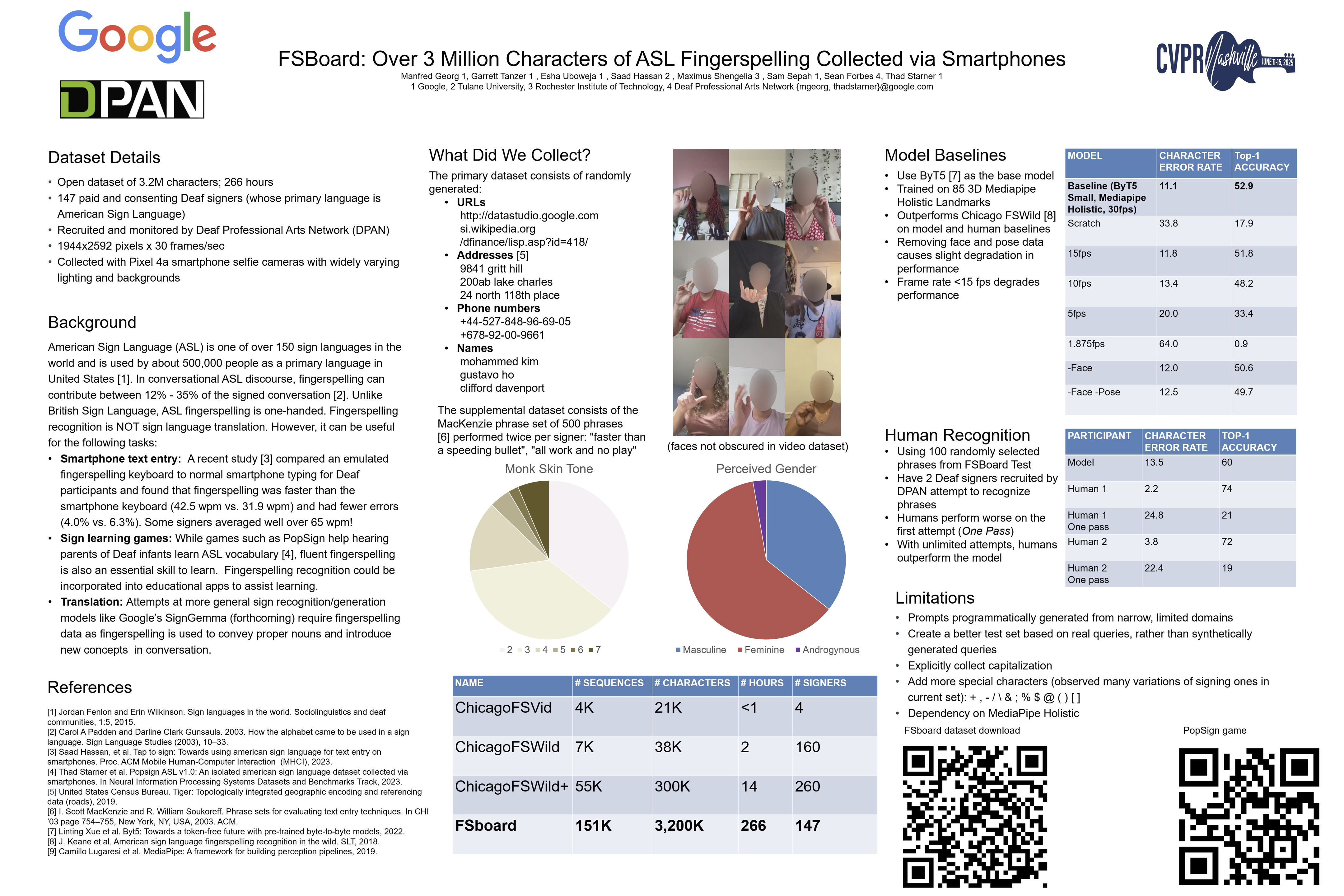
FSboard, an ASL fingerspelling dataset built with Google Research and DPAN, was accepted to CVPR 2025.
A paper on multimodal affective captioning with haptics was accepted to CHI 2025 in Yokohama.
Saad Hassan is Co-PI on an NSF IUCRC planning grant to establish Tulane’s partner site for the AHeAD Center.
Aaron Gershkovich received an Honorable Mention for the 2024–2025 CRA Outstanding Undergraduate Researcher Award.
A journal article on video-span selection for ASL learners was published in ACM TACCESS.
The lab presented two posters at ASSETS 2024, on a rich closed-captioning format and on design sprints with neurodivergent scholars.
The lab co-organized the PACE workshop on participatory AI for community engagement at HCOMP 2024 in Pittsburgh.
Chaelin Kim, Nazmun Nahar Khanom, and Syeda Mah Noor Asad joined the lab as PhD students.
Two CHI 2024 papers, on affective captions and a dance video comprehension tool, received Best Paper Honorable Mentions.
A $102,281 Louisiana Board of Regents award, with Saad Hassan as PI, will support AI-powered tools for ASL learning.
Aaron Gershkovich won the Best Prototype award at the Annual Undergraduate Poster Session.
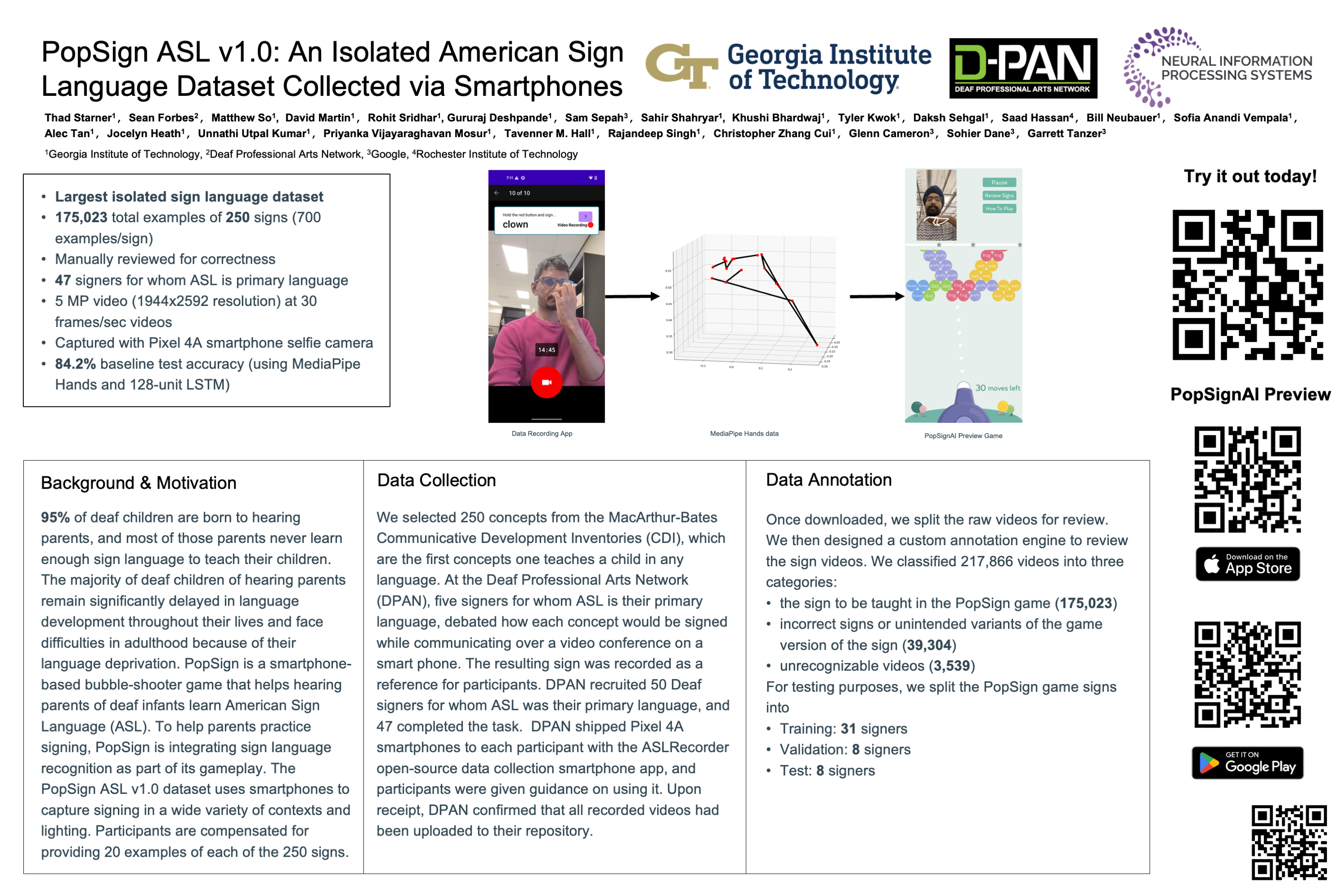
PopSign ASL, a sign language dataset collected through a smartphone game, was presented at NeurIPS 2023 in New Orleans.
Tap to Sign, on American Sign Language text entry for smartphones, was accepted to MobileHCI 2023.
Saad Hassan joined Tulane University as an Assistant Professor of Computer Science.
Tulane CS PhD applications for Fall 2027 are open (no application fee). Tulane undergraduates are welcome too.
AI-powered tools that help people learn, look up, and understand American Sign Language, and richer captions that convey emotion and non-speech information for d/Deaf and hard-of-hearing viewers.
Reading supports such as customizable text simplification, and accessible data visualizations, including personal health information, that help people understand and act on what they read.
Participatory approaches to AI that make public services accessible and connect residents, communities, and local governments, along with the broader social context of AI in public life.
Lab members in bold
PDF NeurIPS Presentation Poster Code Kaggle Data Card BibTeX
Justin Haysbert (2025), Will Silver Wagman (2024)
Yaniv Nagar (2026), Sydney Wade (2025, Honors Thesis), Nikhil Modayur (2025, CRA HM), Oscar Xiao (2025), Madhangi Krishnan (2025), Cameron McLaren (2025), Aaron Gershkovich (2025, CRA HM), Michael M. Weild (2024), Madeline “Dylan” Murray (2024), Caitlin Chen (2024)
Emily Aymond, Madeline Davis, Jaimie Morris (2026); Miranda Diaz (2025, now at Cornell), Zoe S. Oboler, Sam DeMarinis, Hubert Mendez, Ethan Schaferkotter, Izzy Blair (2025); Ryan Stevens, Shayne Shelton, Gabriel Sagrera, Devin Gutierrez, Tanner Martz (2024)
Emile H. Mattei (2026), Mauro E. Nunez (2024)