We build and study computing systems with people in mind: tools that make communication and information accessible, visualizations that explain data and models, and imaging methods for science and medicine.
The Human-Centered Computing (HCC) Group brings together three faculty in the Department of Computer Science at Tulane University, in New Orleans, with their students and staff. We work across human-computer interaction, accessibility, visualization, computer graphics, and applied AI, often with partners in medicine, education, and local government.
The HCC Group will be at ASSETS 2026 in Porto (October 25–28) and IEEE VIS 2026 in Boston (November 9–13).
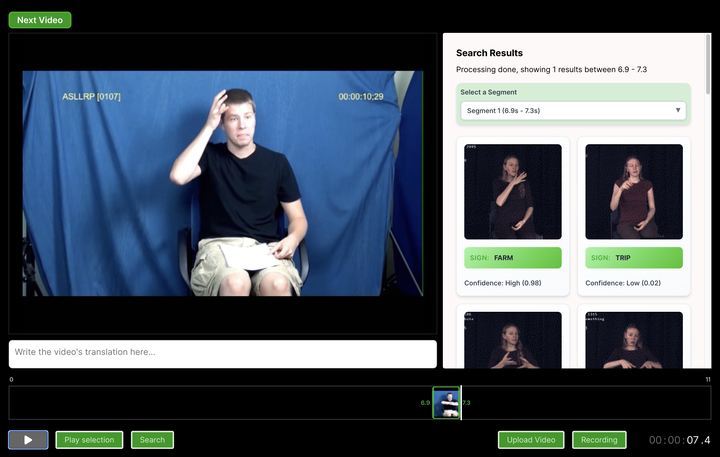
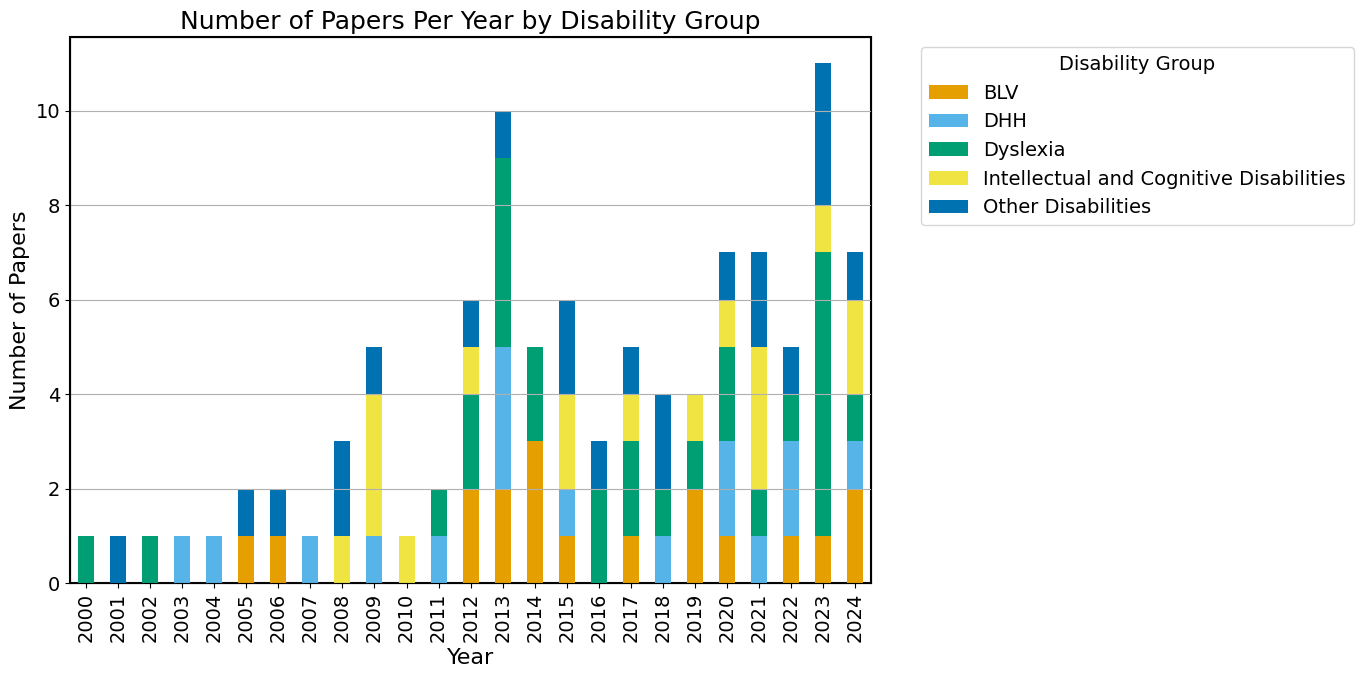
At ASSETS: a scoping review of accessibility research on data visualization by Saad Hassan, Areen Khalaila, and Rebecca Faust, and Chaelin Kim’s ASL video comprehension tool, presented as a paper and a demo. At VIS: KeySI, a framework for tuning text embeddings with human feedback by Yan Zhu, Yongbo Chen, and Rebecca Faust, and a full paper with Rebecca Faust on spatial visual analytics for verifying multi-document summaries.
Tulane researchers aim to reduce cancer treatment time with new tech
Fox 8 featured MAGIC-SCAN, the ARPA-H funded scanner co-led by Brian Summa and Quincy Brown. It maps the whole surface of a removed tumor in minutes so surgeons can see whether any cancer remains. Brian’s group handles the computational processing of the images.
Our team received a new $899,868 collaborative NSF award, with Saad Hassan as PI: Designing Civic AI to Connect Residents, Communities, and Local Governments.
Two papers and a demo accepted to ASSETS 2026: a scoping review of accessible data visualization research, plus an ASL video comprehension tool and demo led by Chaelin Kim.
HistoCAM, led by Cooper Maira, was published in Nature Communications. It digitizes glass slide microscopy in real time as pathologists work, a step toward AI at the microscope.
The work turns everyday microscope slide review into digital data as pathologists work, a step toward AI that assists right at the microscope.
Brian Summa spoke on AI-powered imaging technology for cancer detection in the AI4HealthOutcomes webinar series.
Paper with Wei Liu and Chris North on LLM-augmented semantic steering of text embedding projections accepted to AVI 2026.
Rebecca Faust received a Tulane Committee on Research (COR) Fellowship to design and study haptic data representations on smartphones.
Our lab was awarded three internal grants totaling ~$26,000, including the Jurist Summer Fellowship in AI, the Data, AI, and Community Research Grant, and the Lavin-Bernick Grant, to support research on AI-based reading support tools and accessible personal health visualizations.
Brian Summa presented MAGIC-SCAN in the biotech lightning talks at the Tulane Research, Innovation, and Creativity Summit (TRICS). Details
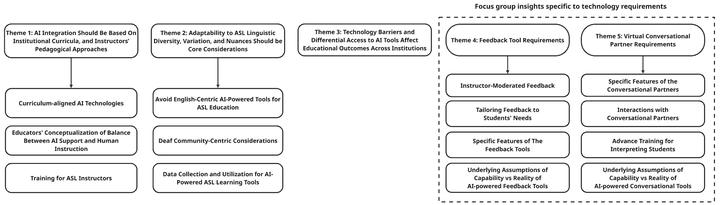
Paper on ASL educators’ perspectives on AI accepted to CHI 2026. Saad will present it at the conference in Barcelona, Spain 🇪🇸! Details
Congrats to former lab member Nikhil Modayur for receiving an Honorable Mention for the 2026 CRA Outstanding Undergraduate Researcher Award! Details
Brian Summa and Quincy Brown received Tulane’s 2025 Convergence Award for research that crosses schools and disciplines. Details
Saad is attending ASSETS 2025 in Denver to present one paper on reading support technologies and two demos. Details
Two demos accepted to ASSETS 2025, led by Chaelin Kim and Nazmun Nahar Khanom, on text simplification and an ASL learning tool for EMS. Will be presented at the conference in Denver! Details
Our workshop on participant recruitment in accessibility research was accepted to ASSETS 2025. Details
Our review of reading support tools, with Oliver Alonzo, was accepted to ASSETS 2025 and nominated for Best Paper. Details
Brian Summa received the Tulane School of Science and Engineering Collaborative Team Award and a Tulane Medicine and SSE Synergy Large Grant Award.
Our lab received two internal grants totaling ~$18,500: a Carol Lavin Bernick Faculty Grant ($10,000) for an AI-powered ASL learning platform and a Community-Engaged AI Summer Research Program grant ($8,500) to build a public accessibility barrier dashboard.
Matyas Bohacek presented our paper on an AI-driven video-based ASL dictionary at W4A 2025 in Sydney. Details
Brad Myers visited our lab in New Orleans to talk about his new book Pick, Click, Flick!: The Story of Interaction Techniques! Details
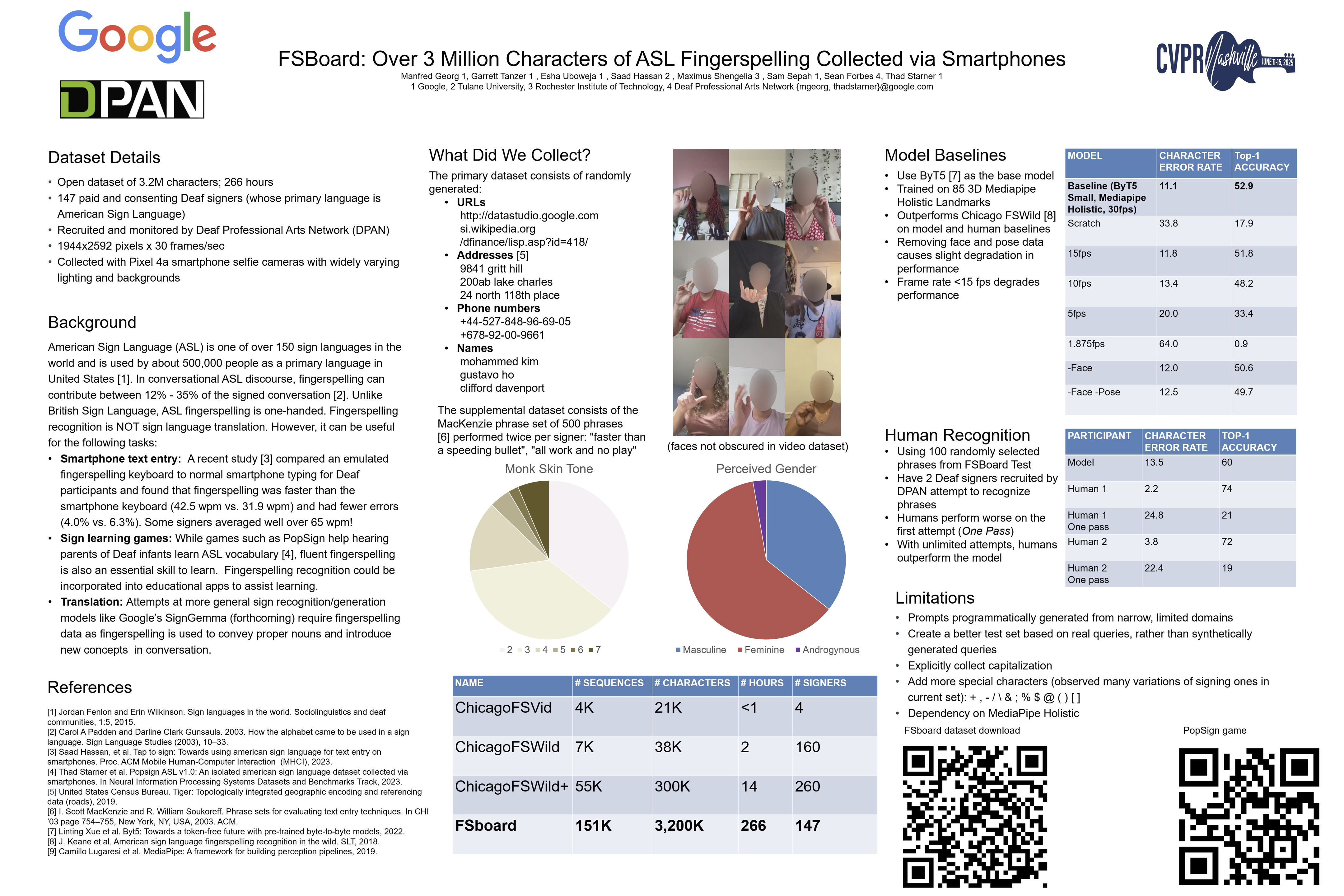
FSboard, an ASL fingerspelling dataset built with Google Research and DPAN, accepted to CVPR 2025. Details
Our paper on multimodal affective captioning with haptics accepted to CHI 2025 in Yokohama! Saad also served on the PC and Best Paper Award committee. Details
Saad received an NSF IUCRC Planning Grant as Co-PI alongside Aron Culotta (PI), Zizhan Zheng (Co-PI), Zhengming Ding (Co-PI), and Sylvia Ley (Co-PI) to establish the Tulane University partner site for the Center for Accessible Healthcare through AI-Augmented Decisions (AHeAD). Details
The Advocate followed up on MAGIC-SCAN, the Tulane Cancer Moonshot project co-led by Brian Summa, as the team builds its next prototype for operating-room testing. Details
Congrats to Aaron Gershkovich for receiving an Honorable Mention for the 2024–2025 CRA Outstanding Undergraduate Researcher Award! Details
Our journal article exploring video-span selection for ASL learners was published in ACM TACCESS. Details
Saad is attending ASSETS 2024 virtually to present two posters on a rich closed-captioning format and designing for neurodivergent scholars. Saad also serves as Workshop Chair. Details
Saad attended HCOMP 2024 in Pittsburgh and co-organized the PACE workshop with Motahhare Eslami, Aron Culotta, Nick Mattei, and Mah Noor. Details
Rebecca Faust and colleagues received a Best Paper award at the Visualization in Data Science (VDS) Symposium at IEEE VIS 2024. Details
Two papers with Rebecca Faust at IEEE VIS 2024: ImageSI, on semantic interaction for image projections, and a compass for temporal topic embeddings in TVCG. Details
Demi Qin and Brian Summa won a Best Paper Award at IEEE VIS 2024 for merge tree neural networks, a fast way to compare topological structure in scientific data. Details
President Joe Biden visited Tulane to announce up to $22.9 million from ARPA-H for MAGIC-SCAN, an AI-assisted cancer margin scanner co-led by Brian Summa and Quincy Brown. Brian demonstrated the system for the President and First Lady. Details
Saad is attending CHI 2024 in Honolulu, Hawaii 🌺 to present two papers on affective captions and a dance video comprehension tool (both received Honorable Mentions!). Saad also served on the PC and Best Paper Award committee. Details
Saad attended his PhD hooding ceremony in Rochester, a year after defending.
Saad was awarded a Tulane Committee on Research (COR) Fellowship ($5,000) for reading support tools for people who are deaf or hard of hearing.
Our lab received a $102,281 Louisiana Board of Regents award, with Saad as PI for our project, "Enhancing Expressive and Receptive ASL Learning Using AI-Powered Tools". Details
Lab member Nazmun Nahar Khanom presented a demo of AI-based reading support tools at the Tulane Research, Innovation, and Creativity Summit (TRICS). Details
Saad attended the CRA Early Career Workshop in Washington, D.C. He met program officers and fellow junior faculty. Details
Congrats to Aaron Gershkovich for winning the "Best Prototype" award at the Annual Undergraduate Poster Session! Details
Saad attended NeurIPS 2023 in New Orleans as a co-author of a paper on sign language data collection for the PopSign game. Details
Jonathan Pool from CVS Health visited our lab! Details
Saad gave a talk at the inaugural NOAI: 11/11 AI Symposium. Details
Saad gave talks at Duolingo and CMU in Pittsburgh on his Duolingo Dissertation Award research. Details
Saad attended ASSETS 2023 to present a demo of an automatic video-based ASL dictionary system and served as Proceedings Chair. Details
Paper from Saad’s Google internship with Thad Starner was accepted at MobileHCI 2023! Thad will present it in Athens, Greece 🇬🇷. Details
Saad Hassan joined Tulane University as a tenure-track Assistant Professor. Details
Brian Summa won a $750,000 Department of Energy Early Career Award to make massive supercomputer datasets easier to share, search, and analyze. Details
Brian Summa received the IEEE Computer Society Distinguished Service Award for serving as General Chair of IEEE VIS 2021.
Papers by Fangzheng Wu and Brian Summa were accepted to ICML 2026, EMNLP 2026, and NeurIPS 2026 (two papers), on diffusion models, language model fine-tuning, and reinforcement learning. Details
Charts and data representations that people with disabilities can explore, from haptic encodings on smartphones to accessible personal health visualizations, grounded in a review of the field.
Participatory approaches to AI that connect residents, communities, and local governments, make public services easier to reach, and examine how tools such as patient-facing chatbots affect health disparities.
Participatory design, Public services, Health equity
Methods that explain dimensionality reduction and deep learning projections, and let people steer them by moving points, grouping examples, or describing what they see in natural language.
Dimensionality reduction, Semantic interaction, Large language models
Software that turns gigantic microscopy scans of removed tissue into fast, navigable 3D maps of tumor margins, and variable-resolution slide imaging that records how pathologists review a slide.
MAGIC-SCAN, PathCAM, HistoCAM, Medical image processing
Customizable text simplification and in-context reading supports for people who are deaf or hard of hearing, people with low English literacy, and other readers who face barriers with complex text.
Text simplification, Large language models, Literature reviews
Tools that help people learn, look up, and understand American Sign Language, and richer captions that carry emotion, sound, and other non-speech information for d/Deaf and hard-of-hearing viewers.
ASL learning, Sign lookup, Affective captions, Haptics
Topological data analysis and learning for comparing complex scalar fields, tools that read and steer the internal states of deep models such as diffusion transformers and language models, and fast access to massive simulation and image data.
Merge trees, Model interpretability, Large scientific data
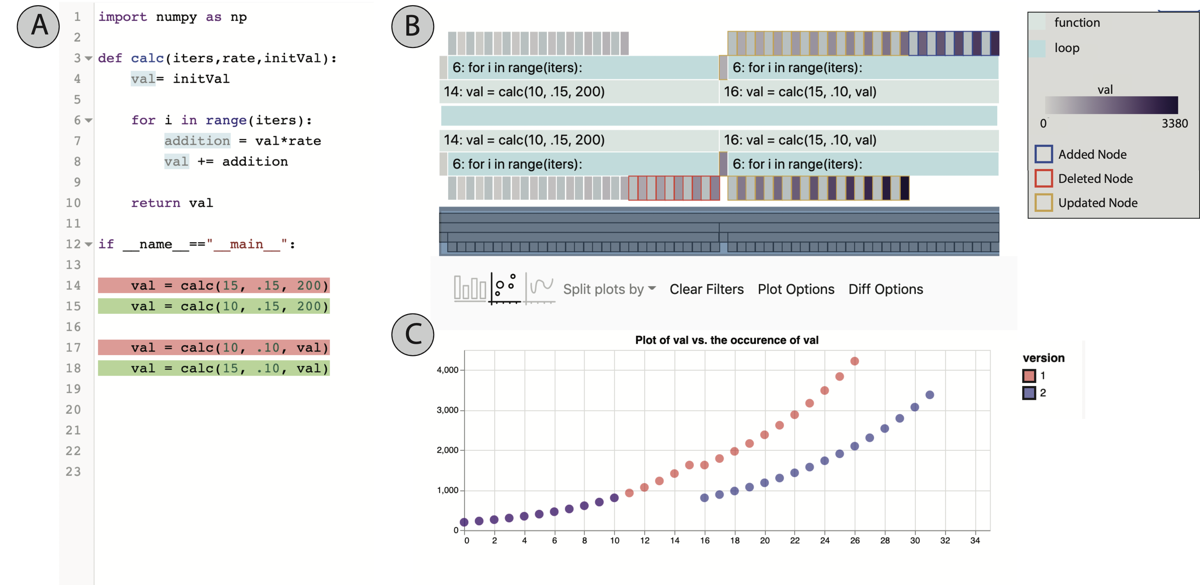
Systems that trace what an analysis script does as it runs and show the values, versions, and choices behind a result, so analysts can debug, compare, and explain their work.
Program traces, Computational notebooks, Debugging
HistoCAM: Datafying the Diagnostic Process and Enabling AI-at-the-Microscope via Ambient, Real-Time Digitization of Glass Slide Microscopy
Cooper Maira, Max Cooper, Kimberly Ashman, Andrew Sholl, Sharon Fox, Shams Halat, David Manthey, Roni Choudhury, Jonathan Sears, Carola Wenk, J. Quincy Brown, Brian Summa
Extreme-Throughput Multimodal Optical-Sectioning Structured Illumination Microscopy for Large-Area Imaging
Ivana Bozic, Christopher W. Simmons, Dylan A. Lucia, Richard C. Todaro, Brian Summa, Peter Kner, J. Quincy Brown
SPIE 2026 short paper
Fresh Surface and Cross-Sectional Slice Imaging with SIM for Prostate Tumor Margin Detection
Ivana Bozic, Grant J. Kobza, Lauren E. Boudreaux, Dylan A. Lucia, Emily Ribando-Gros, Kimberly Ashman, Brian Summa, J. Quincy Brown
Optica MHA 2026 abstract
HistoCAM: Datafying the Diagnostic Process and Enabling AI-at-the-Microscope via Ambient, Real-Time Digitization of Glass Slide Microscopy
Cooper Maira, Max Cooper, Kimberly Ashman, Andrew Sholl, Sharon Fox, Shams Halat, David Manthey, Roni Choudhury, Jonathan Sears, Carola Wenk, J. Quincy Brown, Brian Summa
Syed Fahim Ahmed, Gnanesh Rasineni, Florian Koehler, Abu Zahid Bin Aziz, Mei Wang, Attila Gyulassy, Brian Summa, J. Quincy Brown, Valerio Pascucci, Shireen Y. Elhabian
Multiscale 3-Dimensional Pathology Findings of COVID-19 Diseased Lung Using High-Resolution Cleared Tissue Microscopy
Guang Li, Sharon E. Fox, Brian Summa, Bihe Hu, Carola Wenk, Aibek Akmatbekov, Jack L. Harbert, Richard S. Vander Heide, J. Quincy Brown
bioRxiv 2020 preprint
2019
Assessment of Sampling Adequacy Using Persistent Homology for the Evaluation of Heterogeneity in 3D Histology Acquired through Inverted Selective Plane Illumination Microscopy (iSPIM)
A Nonlinear Model for Interactive Data Analysis and Visualization and an Implementation Using Progressive Computation for Massive Remote Climate Data Ensembles
Cameron Christensen, Shusen Liu, Giorgio Scorzelli, Ji-Woo Lee, Aniketh Venkat, Brian Summa, Valerio Pascucci
AGU 2017 poster
Interactive Scripting for Analysis and Visualization of Arbitrarily Large, Disparately Located Climate Data Ensembles Using a Progressive Runtime Server
Brian Summa, Cameron Christensen, Giorgio Scorzelli, Ji-Woo Lee, Aniketh Venkat, Peer-Timo Bremer, Valerio Pascucci
AGU 2017 poster
Visualizing the Uncertainty of Graph-Based 2D Segmentation with Min-Path Stability
Our research is supported by ARPA-H, the Center of Excellence in Energy, Engineering and Water, NIH, the U.S. Department of Energy, NSF, the Computing Research Association, the Louisiana Board of Regents, and Tulane University. Largest awards first.
ARPA-H
MAGIC-SCAN: Machine-Learning Assisted Gigantic-Image Cancer Margin Scanner
Center of Excellence in Energy, Engineering and Water
Safe, Sustainable, and Resilient Development of Offshore Reservoirs and Natural Gas Upgrading through Innovative Science and Technology (GoMed Consortium)
We are recruiting PhD students and welcome Tulane undergraduates. To apply for the PhD, submit an application to the Tulane Computer Science PhD program and name the co-directors you would like to work with. Undergraduates can email a co-director directly.